I've loved flying contraptions ever since I was a kid. I spent four years in a model airplane club growing up, so I learned how a plane worked before I learned how a car worked. At about ten I took my first flight aboard that soul-chilling horror of the Soviet past, the Tu-154, and figured I'd be taking trains for the rest of my life. Then I grew up and started flying a lot. Just one problem: I'd never tried it myself.
At 18 I got my driver's license. For the next five years or so, all I ever used it for was buying beer at the kiosk. I was a broke student; I couldn't afford a car. At 20, just for fun, I went for my boating license. All it took was two weeks of listening to sea stories from an old sailor who chain-smoked his way through every lecture, and remembering that “shit floats; ships sail.” Armed with that knowledge, you take the exam and get your skipper's license. All I needed for the full GTA experience now was air.
Training for a PPL (Private Pilot License) costs 5–8 thousand euros around here (not much different from Russia). That includes 40 hours of flight time, theory and an exam, and hands-on stuff like flying at night, navigating a route, talking to air traffic controllers, and landing at an actual airport (more on the neat trick they use to save money on that later).
Six months of training and you can start browsing Avito for a Cessna: “Never crashed, original paint, lady pilot.” Park it on the lawn outside your apartment building. Or just show up at the airfield, where by now you're one of the regulars, pay for the rental and fuel, and do whatever you like up there, within the bounds of what passes for decent behavior in a light aircraft. Just like a car!
Someday I'll have six months and eight thousand euros to spare, and I'll go get a pilot's license and lord it over everyone. Not yet, though, so I was happy just to go flying with an instructor for 150 euros an hour. Best birthday present ever!
I'm just sharing my impressions here. I still don't know a thing about aviation. So go easy on me, guys.
I can't help it, this guy just looks really pleased with himself
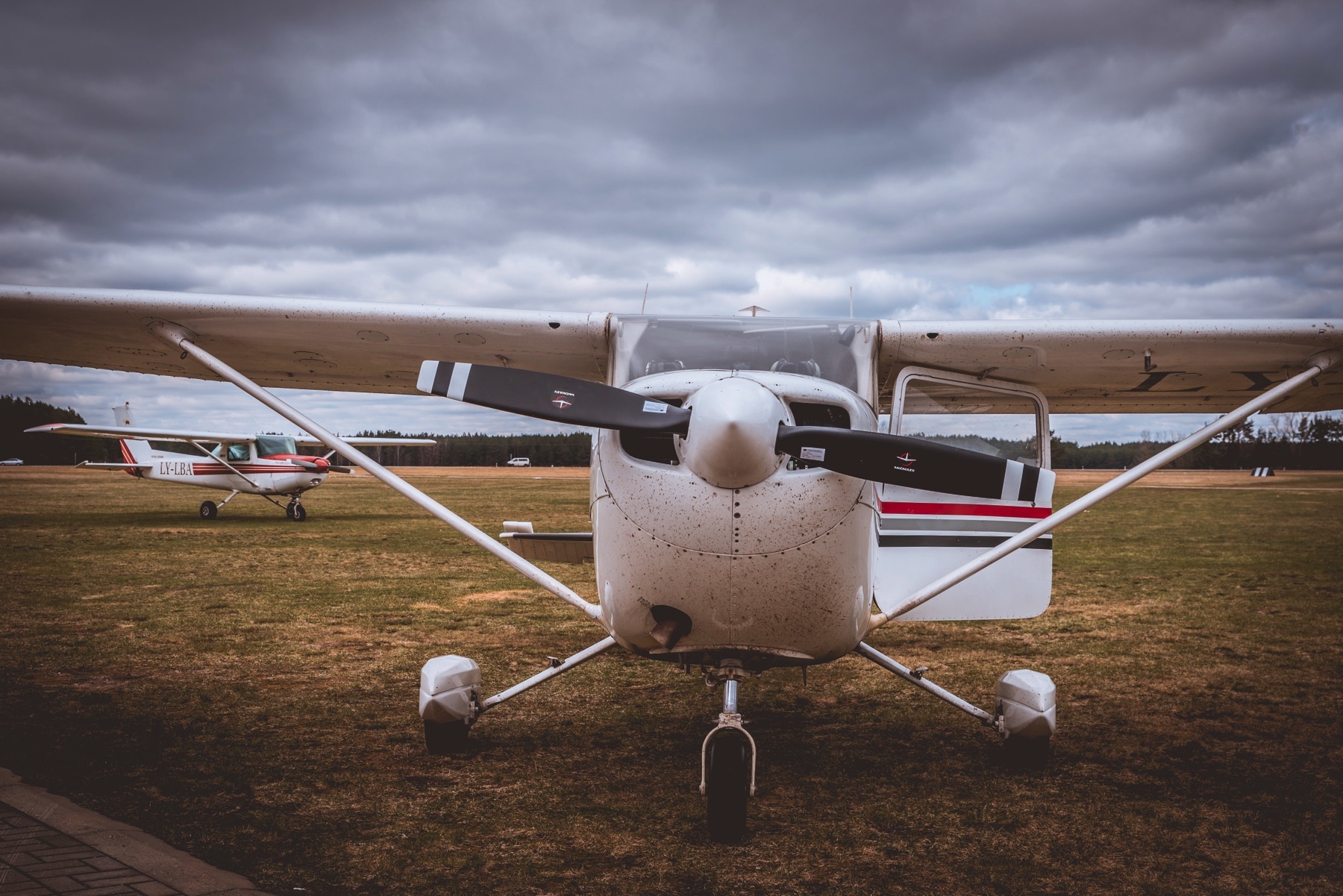
The Cessna 172 is the most-produced aircraft in aviation history. More than 43,000 have been built since 1956, in over 25 variants
One door on each side. That makes it a sporty little coupe!
Remember the German guy who landed in Red Square in 1988 and caused a massive scandal for the air defense forces? Yep, he did it in a Cessna 172
What's life like in light aviation?
I've always noticed how people who fly or go to sea form these tight-knit brotherhoods. Maybe it's because what they do is dangerous, I don't know. I mean, get a driver's license and walk into some stranger's garage and you'll probably get punched in the face. Walk onto a little airfield with a pilot's license, though, and by nightfall you'll be getting drunk with the locals, swapping stories about life and what pilots get paid. Handy. Although it'd probably work without the license, too.
Not many people stick around in light aviation. For most newcomers it's the first step toward flying the big stuff: passenger flights, cargo, military, or rescue work. Competition for airline pilot training is fierce, and the majority who don't make the cut go off to learn on crop dusters.
Others get into aerobatics. All they want out of life is to pull 7 g and get sponsored by Red Bull. Even if that doesn't work out, you can always become an instructor and teach the next batch of little shits that “shit flies; planes sail,” or whatever the aviation equivalent is.
Plenty of pilots find their way back to light aircraft whether they want to or not. Here in Lithuania, the only local airline, flyLAL, went bust in 2009. Airlines in other countries snapped up some of its pilots, but not everyone was ready to relocate or take the new terms. Those guys went back to flying little planes.
Their main job now is training new pilots. Sometimes an interesting gig comes along: delivering cargo, dropping off skydivers, finding lost mushroom pickers, helping farmers with their crops, or taking tourists up for a ride. That last one's a side gig, like driving a cab. Judging by the empty booking calendar, you won't make much off tourists here. Maybe sightseeing flights are in demand somewhere like Barcelona. Here the instructor just says, “Sure, come by on the weekend, we'll go flying,” and goes back to sipping his tea.
A typical little airfield: couches, a water cooler, maps, binders of paperwork, and a clock with a slip of paper taped to it that says “UTC”
Air traffic control. Seriously. Little planes, little control room
Checking the oil before the flight. Dad said you're supposed to kick the tires, too!
Eh, still got some life in it
The airfield
We get to the airfield in the morning. It looks like a nice green patch of grass. Only when you look closer do you notice a few distinguishing features, like little flags and holes in the grass for drainage.
The instructor pulls our plane out of the hangar on a bit of rope. It's about ten times his size. You wouldn't think it to look at it, but this thing's really light: a little over 500 kg. Even a car is harder to push. Your average guy could easily push a Cessna all the way home, so tie yours to a tree at night. I got a bit of video:
Since it's always the dumbest things that interest me, my first question is: does the plane have keys?
Turns out it does. Little planes like ours often have locks on the doors. Not so much to keep someone from stealing the plane as to keep them from swiping stuff out of it, since it often spends the night outside. It's the simplest little flat key, like you'd use for a bathroom door. Nothing like a fancy cut car key.
The Cessna 172 in particular has an ignition key. The funniest part is that it's the same key that opens the doors. Basically, turning the key just closes the battery circuit, because the Cessna has an electric starter just like a car. They often replace it with a plain toggle switch so nobody has to figure out where in the hangar they lost the key. Looks like this:
Big Boeings and Airbuses don't have keys at all. Not for the doors, not for the ignition. So if you ever fancy stealing yourself a Boeing, just pull the handle and come on in. Here's Captain Joe explaining it all on video, with examples.
Little holes in the grass at the airfield. For drainage, as I understand it. Or not? Let me know in the comments
Planes have pedals, even the big ones. Except these move the rudder (the bit on the tail fin) left and right. They're mostly used on the ground, on the takeoff roll and on landing. Less so in the air. You don't yank the handbrake while your car's moving, do you? And when you do, you presumably know what you're doing and what might happen. Same deal here
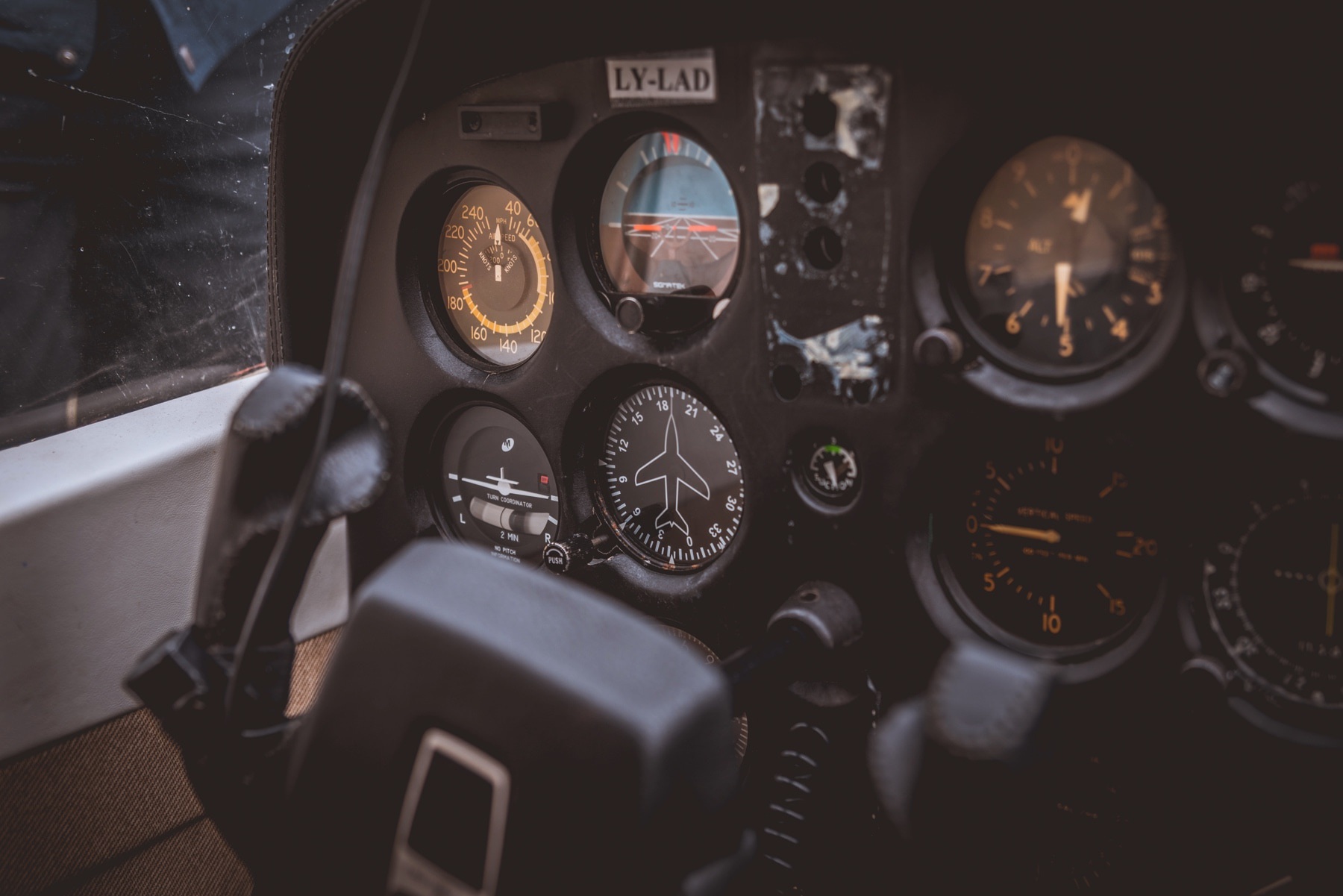
The standard “six-pack” of instruments. You'll find them in any plane. Airspeed indicator, artificial horizon, altimeter (altitude), turn coordinator, compass, vertical speed indicator (rate of climb or descent)
Don't piss yourself. I'm pissing myself too
On the ground
Having hauled the Cessna out of the hangar, the instructor looks up at the clouds rolling by and says, “Ooh, we're in for a fun bumpy ride. Pissing yourselves yet? Let's go get gas!”
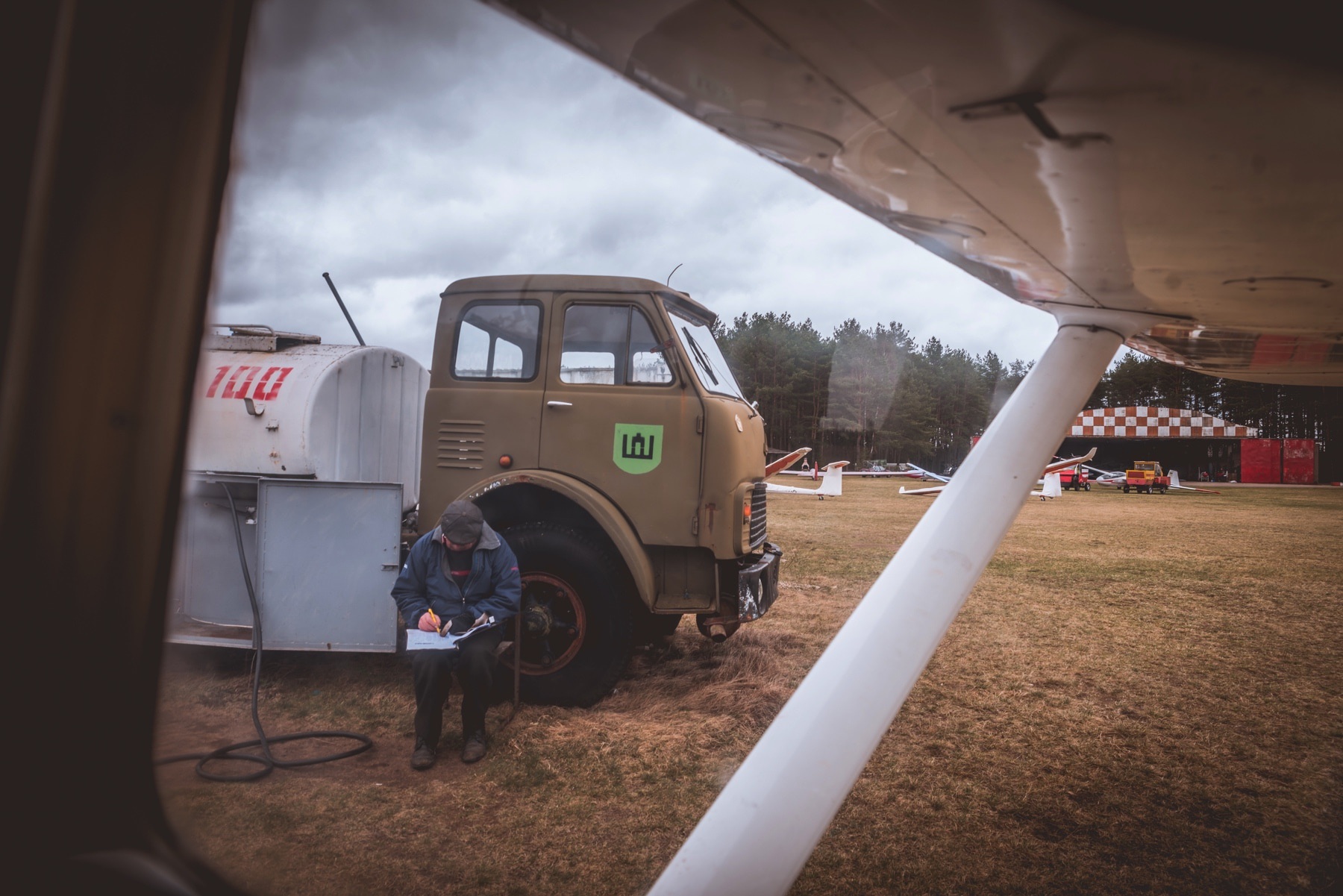
The gas station is a fuel truck in the middle of a field, with an old-man NPC sitting next to it, STANDING GUARD. To trigger him into dispensing gas, you have to sign his magic book. Yep, the Cessna runs on gasoline rather than kerosene, because it has a piston engine. Not 95 or 98 octane, though. It takes 100, the stuff street racers like. I hear some gas stations have started selling it. But our Cessna's from the '80s, and back then this was considered special aviation fuel.
The wing tanks hold 160 liters, and this contraption guzzles about 30–40 liters an hour at cruising speed. Which means half the price of the flight is just gas. Very rough figures, because there've been a crapton of models, and there's always room for a bit of creative DIY. I bet in the Caucasus they lower their Cessnas and put fancy rims on them, just like their Lada Prioras.
After fueling up, the pilot drains a little gas through holes in the wings into a jar to make sure there's no sediment or anything else that could kill us. We get in, start up, and head for the runway.
Uhh, what about open your life vest, put on your window shades, the masks drop from here and then everybody dies? Pfft, no. Light aviation is hardcore. Get in, let's go kick that cloud's ass.
As this rattling barrel with little wings goes tearing down the runway, it doesn't seem like it could possibly fly. But if the Cessna 172 is the most-produced plane in history, it must be able to, right? Right? Oh, we're flying already? Fuck fuck fuck.
The old guy with the fuel truck. Tell me he doesn't look exactly like an NPC you get a mission from
LL100 means that same 100-octane gas our Cessna guzzles
In the air
Inside the plane it's BRUUUTALLY loud. Think Moscow subway, only a bit louder. Nobody feels sorry for Muscovites, but pilots' precious ears need protecting, so everyone gets a huge noise-isolating headset. They're great, every bit as good at keeping the noise out as those Bose QC 35s of yours, though they weigh about three kilos. I should get a pair on eBay.
To let you talk to each other, the headset has a handy little mic on a boom. Well, “handy.” The threshold for picking up sound is set so high you have to talk really loudly or press the thing right up against your lips. The quality is awful. You've probably heard recordings of pilots talking: it's exactly like that, you can barely make out every other word. And since our instructor had a Lithuanian accent, I couldn't make out anything at all.
I did learn one interesting thing, though: conversations inside the plane go strictly over the wire. You can't pick them up from the ground. When the pilot needs to talk to a tower, he presses a special button and his voice goes out over the radio.
All the airspace is divided into zones, each with a frequency for the tower that covers it. The pilot has a paper chart (OLD SCHOOL!) showing the zones, and an old monochrome GPS that can dial the right frequencies straight into the radio.
When pilots enter a zone, they say hi to the controller and can hear each other. Same goes for the big planes, only their zones are bigger and higher up. Big airports have zones of their own with the strictest rules. People generally try not to fly into those unless they have to. You can get your ass handed to you. Here's a map of the zones in Russia.
Otherwise, up there you're free as a bird. At altitudes like ours (500 meters), you don't even have to clear anything with anyone. Fly where you like. Our pilot points the plane where he wants it to go, tells me, “Here, take the yoke, have a go,” and gets absorbed in his phone.
Seriously, he's sitting there tapping out messages to someone on WhatsApp! Well, why not? It's not a car, you're not going to drift into oncoming traffic or hit a moose. No traffic cops to pull you over, either. And the phone gets great reception up here, so why not mess around on it? That's when I realized that in light aviation it's customary to chill. Probably in the big planes, too.
A paper aeronautical chart showing the zones and their frequencies. See those rectangles that stand out? Those are the zones for Vilnius and Kaunas airports. And that scary red line is the national border. That's Belarus over there. Best not fly that way
That green monochrome screen is the GPS. Does the job. Below it is the radio.
“We'll be flying at an altitude of 20 meters, but we can climb to 30 meters if we see SOMETHING BIG in front of us” (this is actually what 500 meters looks like)
Taking the controls for the first time was genuinely scary. Not just because a yoke has more degrees of freedom than a steering wheel, so I kept pushing it slightly away from me and losing altitude. The real problem was realizing that the damn plane doesn't fly in a straight line! Depending on the wind, it goes wherever the hell it wants. Specifically, in the direction you get by adding its velocity vector to the wind's. As far as the plane's concerned, that's “forward.”
It's like driving across the side of an icy hill. You think you're steering straight, but you keep sliding sideways and you have no idea what's going on! It feels like there's no way you could fly this thing in exactly the direction you want. But you can, and it works pretty well. You don't even have to keep adjusting the controls. That's what trim tabs are for: they compensate for deviations from straight flight by mechanically moving little surfaces on the rudder, elevators, and ailerons (now I'm definitely going to get my ass kicked in the comments for not knowing the terminology).
The second thing that hits you is just how easy it is to make everyone in the cabin go “WHEEEEEE!” In a car the steering gets heavier at high speed. In the plane the yoke feels the same; all you feel are the gusts of wind. A slight movement is enough to make you feel completely weightless or three times your normal weight.
The instructor took us over a couple of those “hills” for fun. It's not as easy to take when you're inside as it looks in videos on the internet.
Otherwise, flying a plane is actually easier than driving a car. No oncoming traffic to worry about, no bouncing around in ruts on a bumpy road, no staying in your lane. The whole thing feels a bit like being in a boat. Free movement in 3D space. Sure, my palms got sweaty that first time, but maneuvering through traffic on Moscow's Third Ring Road usually takes a much bigger toll on my nerves.
Vastrik at the controls. Pissing himself, but staying calm
But it's so damn cool to be able to bank the plane for a better look at that beautiful castle in Trakai
That round thingy is the trim wheel I was talking about. The knob at the bottom lets you switch between the wing tanks (just like in a UAZ). And on the radio you can see the latest trends in eco-design
Do big airports pick on little planes?
After the flight I still had one unanswered question. Say I buy myself a little crop duster and decide to take it on a Eurotrip, hopping from city to city. Would they let me land at, say, Amsterdam airport?
Turns out they very well might. An airport is like a hotel for planes. If you need to land, you just call the controller on the right frequency, request a landing, and follow their instructions. Right there on that enormous runway the real Airbuses land on, if there isn't another one.
Of course, if you want to land somewhere busy like Sheremetyevo or Heathrow without arranging it in advance, they'll send you to a nearby airfield (unless it's an emergency), but in theory it's possible.
Google “landing fee at XXX airport” and the prices are actually pretty reasonable. Landing in Vilnius will cost you €3; at Tolmachevo, 310 rubles; at Sheremetyevo, 154 rubles for domestic flights, $10.50 for international (though the sneaky bastards tack on a bunch of fees for things like “navigation”); in Kyiv, $5 domestic, $14 international. Those are prices per metric ton of takeoff weight. A Cessna comes in at about a ton, but for an Airbus A320 you'd have to multiply by 560 tons (PRICEY!).
Have a look at the airport price lists in those links. You can really get sucked in. You usually get three hours of parking for free, a set of boarding stairs costs 3,000 rubles, renting the “tube” costs 5,000 rubles an hour, and a bus to take the passengers to the terminal is 2,000 rubles. It's practically Uber Black!
It still works out too expensive in total, because they immediately add a bunch of fees for airport security, use of the terminal, and passenger handling. That's why people prefer not to land at big airports.
In theory, if you planned a route between little grass airfields like ours, you could have a pretty good shot at flying all over Europe. Too bad those airfields tend to be a long way from the big cities. You'd have to bring a car along, too!
The dash is no more complicated than the one in a UAZ
Handy when you can put the exhaust right under the engine instead of rigging up a whole bunch of exhaust pipes
Now for that story I promised about students and big airports. To get a pilot's license, a student has to make several landings at a major airport. For us, for instance, that's Vilnius airport. So what, you pay every time?
Turns out, no. Airports often cut new students some slack and are happy to work something out with flying clubs. Our guys have a lovely arrangement with VNO: students fly in during quiet hours and go through the whole landing procedure, except for one little detail: once they've landed, they start taking off again.
Vilnius airport has a standard-length runway: 2,515 m. A Cessna 172 needs 290 m for its takeoff roll and 170 m for its landing roll. A student doesn't just have room to land and take off again. They could do it several times along that one runway! (Nobody actually does that, of course.)
The airport does them a solid and doesn't charge for these touch-and-goes. They're free by agreement. They don't tie up the runway, and it takes hardly any equipment or staff time. All you need is a controller, and there's always one there anyway. As long as nobody's coming in to land, why not put the students through their paces? They'll be coming to work for you one day.
The headset weighs a couple of kilos, but it does a damn good job of keeping all that noise out
One very tough guy. Still pleased with himself, though
To wrap up: fear of flying
Everyone's afraid of flying, just to different degrees. Even my palms got sweaty when our A320 nearly scraped a wing on landing at Vnukovo. You can know all there is to know about how planes work, tell girls why an Airbus has a hole in its ass, what the numbers on the runway mean, and why you have to turn off your phone for landing. But taking the controls yourself will still change how you see things.
It's only when you feel it for yourself that you start to understand just how at home planes are in their element. Pulling Gs or going completely weightless is as ordinary for them as asking the flight attendant for a tomato juice is for you. That's why they ask you not to hold your iPad during takeoff and to take off those giant Cheburashka-ear headphones. Not because of some hypothetical emergency.
You start to appreciate just how precisely and smoothly airline pilots do everything. Because if they wanted to, they could easily fly these things in a way that'd turn the whole cabin into one big happy puke-a-thon. Maybe the automation won't let them, or maybe it actually helps, but now every time I fly I'm amazed at how polished it all is.
You start to feel the subtle difference between “that was rough, the pilot kinda lost it” and “that was tricky, but they nailed it; I'd even clap, but then I'd look like a total shithead, so I'll just make the Not Bad meme face and try to catch a glimpse of the crew on my way out.” (It's like seeing someone nail a parallel parking job on the first try. That makes me want to clap, too. MAESTRO! ENCORE!)
I recommend everyone try flying a plane at least once. Find a flying club in your town and treat yourself. Summer's best. A couple hundred euros isn't that much to pay for that feeling. Not even a new iPhone comes close.
Happy flying, everyone, and as the saying goes, may your number of landings always equal your number of takeoffs.
P.S. I know how much you love that fun game called “Why do you need a fancy camera on your phone?” Half the photos in this post were taken on a getting-on-in-years iPhone 6S, the other half on a full-frame DSLR. Did you notice the difference?
 Vastrik