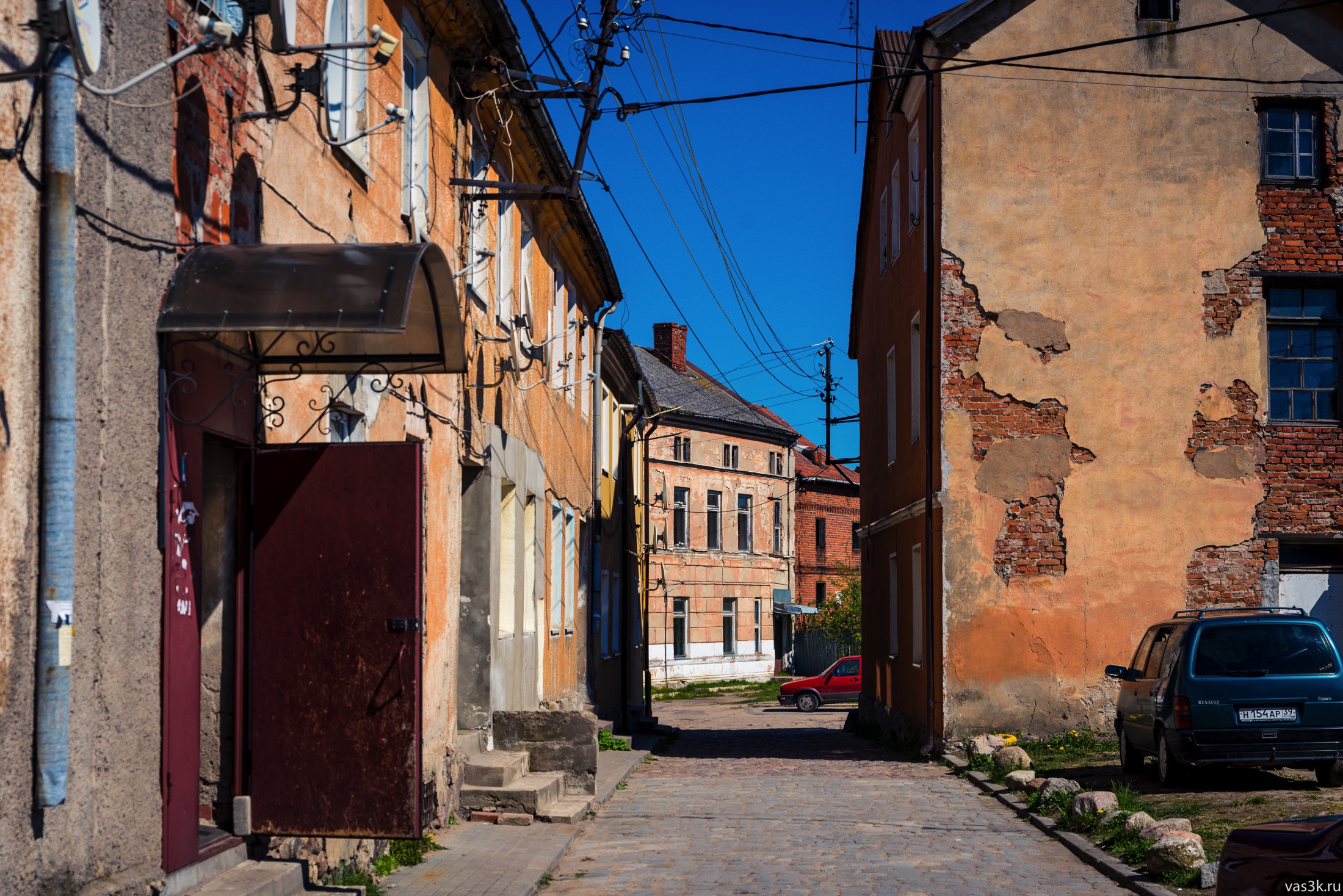
Once you start trying to make sense of what you’re looking at, every scene feels like something out of an old sci-fi novel about an alternate history. Shabby Soviet apartment blocks grafted onto German houses, Gothic churches with signs that say “Russian Orthodox Church,” a “Pioneer Street” sign over a barely legible “Kirchenstrasse.” Seventy years ago, history here was rewritten by force. The place is steeped in surrealism, but sensing it is about as easy as making out the old German Fraktur lettering on the bricks under layers of peeling Soviet plaster.
I want everyone to get a chance to see the Kaliningrad region this way. Let’s start with a quick bit of history for anyone who hasn’t got a clue (I didn’t either).
In the fifth century, this was home to the Prussian tribes. Historians used to mistake them for Slavs, but really they were more like ancient, feral Lithuanians and Latvians. Like any regular guys back then, the Prussians spent most of their time kicking their Polish neighbors’ asses for profit and orgies, then getting their own asses kicked by ancient Swedes who’d turn up out of nowhere by boat (Vikings, Varangians, whatever else they called them).
The Poles put up with this for about 500 years, then got sick of this shit. The Holy Roman Empire had conveniently sprung up next door (where Germany is now), complete with a federal crusades program. They wrote to the Pope asking him to send over the Teutonic Knights. Back then, nobody was better than those guys at explaining to absolutely anyone why they needed to convert to Christianity right this minute.
I always wondered how Kant went down in history as a “great Russian philosopher.” Turns out the Russian Empire grabbed a chunk of Prussia in 1758 as a result of the Seven Years’ War and held on to it for a whole four (!) years. In those four years Kant got friendly with Empress Elizabeth and swore allegiance to her, which made him “ours” until König was handed back to Prussia in 1762.
The Teutonic Knights rode in, kicked the wild Prussians’ asses and slapped up castles all over the region. One of those castles happened to be Königsberg. Not a city yet, just a castle. The locals were taught to speak German instead; anyone who objected was slaughtered or run off. Then the knights started picking on the Lithuanians next door: hey, you’re savages too. But the Lithuanians said “ne, ačiū” (no thanks) and went off to invent diplomacy with the Poles.
The Poles and Lithuanians actually did come up with a republic (the Polish–Lithuanian Commonwealth), teamed up to kick the Teutonic Knights’ asses, and took away almost all their access to the sea. They left the Prussians alone. Over the next 500 years, every half century or so, the Swedes would come kick their asses, or the German tribes (going by a new name) would want them back, or the Russian Empire and the Swedes would divvy them up without asking anyone. Who needs that headache?
The facade of an old German pharmacy. Soon they’ll tear this down too...
500 years later
The interesting part starts after World War II. Under the Potsdam Agreement, this part of Prussia went to the USSR. Or rather, what was left of it after the British air raids. But the people who lived here were German, and after the war nearly every country started expelling its Germans back to their homeland. The Soviet Union couldn’t sit this one out. Repression, after all!
The Germans were driven out so brutally and so fast they weren’t even allowed to take their things. So they buried their valuables in their yards: old dinner sets, bottles filled with jewelry and precious stones, all carefully tucked away underground. They thought this was temporary, an echo of the war. In a few years they’d come home and dig it all up.
But as we know by now, they wouldn’t get to. Hunting for buried German treasures and selling what you dug up would become a popular hobby. It still pays to this day.
By 1947 there wasn’t a single German left in the territory, and “families of workers and peasants” from “all the republics of the Union” were being invited to “develop the new territories,” on a strictly compulsory-voluntary basis. Families from Siberia, the Urals and elsewhere arrived in what was essentially a city its inhabitants had just walked out of. They were moved into German homes where the flowers in the kitchen hadn’t even had time to wilt. Into apartments where just yesterday a different family had lived, in a different country, speaking a different language.
This is what the royal castle looked like. You can just make out some of its ruins in the video above, right behind the House of Soviets. They never rebuilt it.
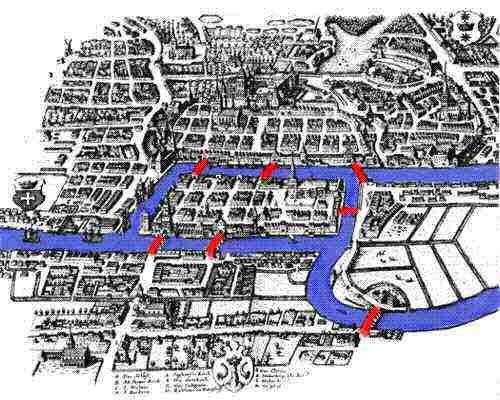
The waterfront is a new build, of course. I love how that prefab block peeks out from behind it. Like, psst, hey kid, wanna buy some gloom?One of the famous “seven bridges of Königsberg” that gave birth to graph theory (more on that below)
Kant’s grave (actually a fake). A little stone with the four questions of his later critical philosophy.
An artificially resettled region
The most ironic part? The Soviet settlers hated the German houses. The windows were too big, it was too cold, the layouts were weird and the entrances opened onto the street. They’d rather move into newly built Soviet hovels with three-square-meter kitchens, the great-grandfathers of the Khrushchev blocks. The German buildings were eagerly “modernized” to match: apartments were split in two and soldiers’ barracks turned into cramped communal flats.
And that’s how the Kaliningrad region got an entirely new population. German names gave way to Soviet ones. Tilsit became Sovetsk, Friedland became Pravdinsk, Insterburg became Chernyakhovsk, and Königsberg, of course, became Kaliningrad.
The apartment we stayed in was in an old German barracks. You couldn’t tell from the outside anymore, but inside it was plain as day. The windows, deemed too big and inexplicably round, had been shrunk and turned into “normal plastic ones.”
What was left of anything German in the region was systematically destroyed. Brick buildings were taken apart brick by brick and the bricks shipped off to Russia. Some houses in Nizhny Novgorod were rebuilt with German bricks, or so they say. Only the occasional hint of the German past remains, the kind you’d miss if you didn’t know what to look for: houses laid out differently, each entrance numbered as a separate house, the odd German inscription on the burnt-out facade of an old building. They’re unlikely to restore any of them. More likely they’ll tear one down and put up a supermarket.
Even in the apartment we stayed in, you could see how the big, round-topped window openings had been turned into little square ones, now graced with plastic windows. One look at the kitchen and you knew this room had once been something quite different. Part of the wall stuck out; most likely there’d been a chimney there. German barracks of that era were heated by little stoves like that. You could see them at Auschwitz, for instance.
We sat there in a thoroughly post-Soviet apartment with an old MECHTA hot plate, floral wallpaper and yellowing plastic windows. But if you looked closely at the faintest details under the flaking plaster, you could see just how different this building was underneath. It hadn’t been like this. It had been made this way. That metaphor works for the whole Kaliningrad region.
Beautiful and completely fucked at the same time
Walking around guessing who built each house is a whole side quest. Take this one. Clearly doesn’t look German: too much detail, the Germans built in a very simple style. Doesn’t look Soviet either. What do you think?
This one’s German. Notice how those two windows on the left used to be one big window. You can tell from the brickwork.No prizes for guessing this one. I particularly enjoy how they insulated just bits of the walls.
The monumentally bleak prefab blocks add to the atmosphere. One look is enough to give every passerby an existential crisis.
Exemplary upkeep is the most important of all the sciences
First I cracked up at where they’d put the sign. Then I remembered I was standing on German narrow-gauge tracks and it’s been ages since anyone saw a tram that could run on them.
Time seems to have stopped here sometime around ’86
And here, more like ’65
Repair Street, despite the name, has quite a bit of atmosphere
Oh, the ironyThe fluffy bastard was excessively friendly
How I love these little courtyards and fences, Russian since time immemorial!
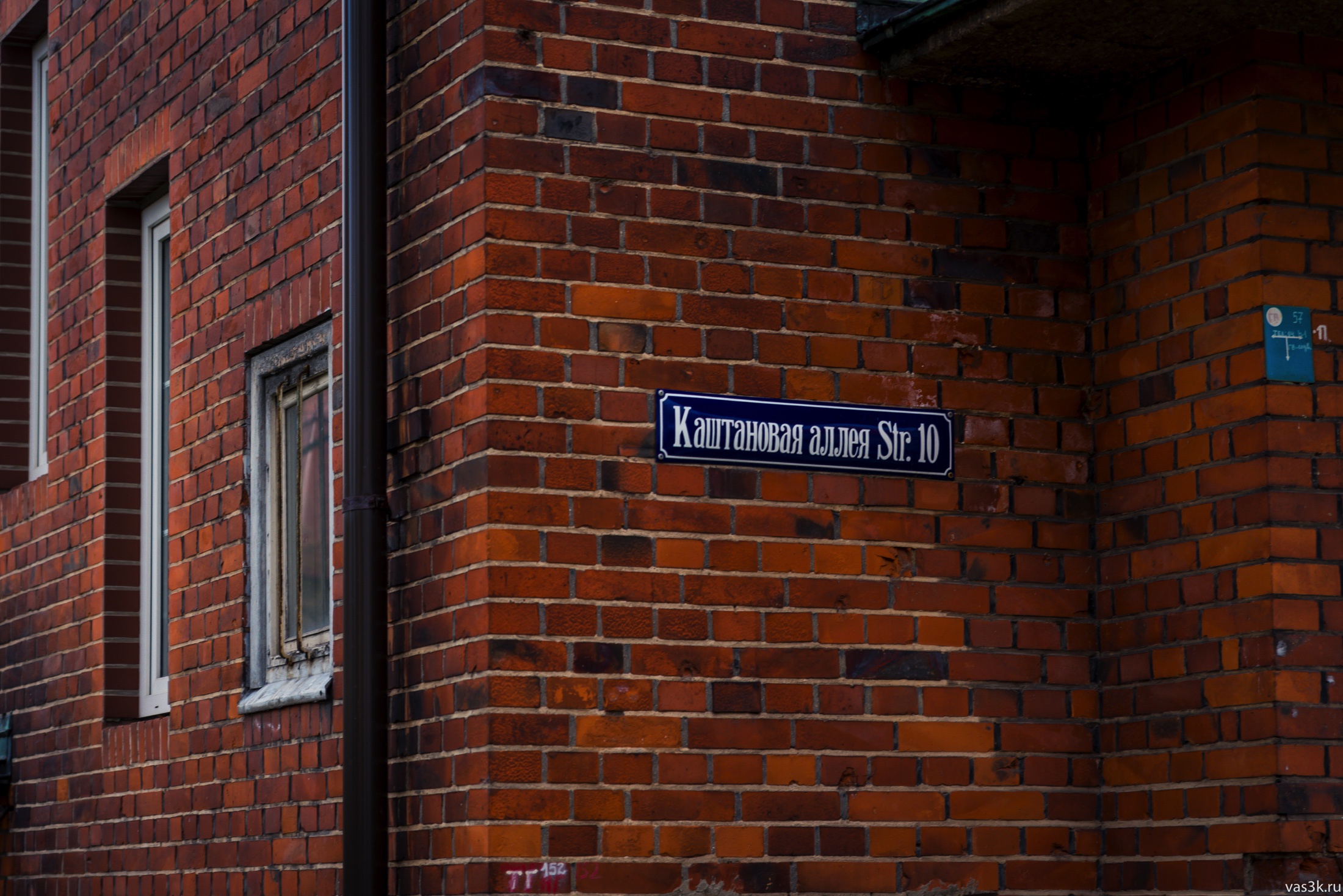
At least somebody made the “Kashtanovaya Strasse” joke. That would’ve been my first move, come on.But surely the proper wording is “On to Berlin”
WUT? Is this a joke? Or a place from some Strugatsky brothers novel?
Nostalgia tourism
A BMW with German plates was ahead of us in line at the Lithuanian border, and over the next three days we saw about a dozen more cars from Germany. You don’t see that many even in Lithuania itself. The people in those cars are doing something popular among descendants of the Germans from Königsberg: “nostalgia tourism.”
The nearly 400,000 Germans driven out of here 70 years ago found new homes, started families in Germany and told their children their stories. They described the houses they’d lived in, the things they’d left behind or buried, the train ride and what went through their minds back then. Now their children and grandchildren are growing up and want to see their parents’ stories for themselves.
Even I wanted to see the dorm where my parents lived when I was born, the first time I went to Moscow. I can imagine what it must feel like for the children of those Germans. They’re not just seeing their own history. They’re seeing a distorted version of it. Where “Sackheimer Kirchenstrasse” is now “Pioneer Street,” and the house looks just like it did in Mom’s photos, only it’s completely different.
Königsberg had its famous seven bridges problem: how do you cross all the bridges without crossing any of them twice? Leonhard Euler was the first to solve it. He managed to prove it couldn’t be done. The Königsberg bridges problem gave birth to graph theory, and its solution introduced the world to Eulerian circuits.
Nostalgia tourism is a genuinely cool idea. Even Germans with no family ties to the place are eager to come see this bit of “former Germany.” Imagine if, say, the Chinese had taken over the Tula region half a century ago, moved their own people in and rebuilt the place. Stuck Chinese monastery roofs on old Russian churches, with vintage matryoshka dolls for sale on the street next to vats of rice and cabbage.
I’d be first in line to see a marvel of human history like that.
So Germans today get in their BMWs, jump through all the hoops for a Russian visa and zip off to Königsberg. Here’s the surprising part: with such a unique kind of tourism on offer, and actual demand for it, what does the regional government do? Organize tours? Set up programs? Print maps in German? No. It advertises beaches.
Tourism in Kaliningrad, according to its government, means going to Svetlogorsk (the local answer to Yalta) and stuffing your face with shashlik at a seaside dive called something like “Prussian Corner” (BEER! VODKA! AMBER! DISCOUNTS!)
Svetlogorsk is the main resort town. A textbook specimen. I had to launch the drone from the bushes to avoid the constant “whoooa holy fuck heeey pssst c’mon lemme fly it,” and I still had to make a run for it to get away from the drunken assholes at the end.
These are the shots I took from the bushes. Never got to walk out on the pier myself; I was too busy getting away from the local thugs.
The Curonian Spit. Beautiful. Unique. Just like in Lithuania.And it’s a lot more interesting from the air than from the ground.But there are viewing platforms like this for those who can’t do air.
There’s next to nothing to see or do in Svetlogorsk. The whole place looks like it came out of a mold labeled “typical Russian resort.” But there are hairy little houses, which is cute.
Domestic tourism
From the “Look, Mom, I’m in history!” collection
Look, the beaches are pretty, the Curonian Spit is fine too, but the official tourism pitch actually hurts. König and the whole surrounding region are a unique, surreal place, but you can’t feel it if you go in cold.
If I’d come to König with different people I might never have suspected anything was off. I’d have wandered over last year’s already crumbling paving stones, looked at the dirty streets, the cracked facades and nine-story prefab blocks with tar smeared over the seams. I might’ve caught a few “anomalies” out of the corner of my eye, but I’d never have stood outside a house imagining IN 3D what it looked like before.
Once you start thinking about what’s going on around you, the whole thing turns surreal. This can’t be real. It’s some Strugatsky brothers novel or vintage American sci-fi about people getting dropped into a warped timeline. Somebody took history here and deliberately sent it off in another direction. It shouldn’t be like this. It’s all so strange, and yet all too real.
But it doesn’t just come to you. You have to look closely, switch on your imagination and try to picture what used to be here and what it was like. That’s the problem with tourism in the Kaliningrad region in general. Even Googling it turns up some kind of lifeless shit.
“Come relax on a beach on the cold Baltic Sea, where the water never gets above 15°C even in peak season,” proclaim the pages of the tourism development plan. Sorry, what the fuck for? I get that you can never have too many Yaltas and Anapas, but open your resorts somewhere with no history. The Krasnodar region, for instance, heh heh. Not here.
Don’t try to make another Sochi in a place where history is RIGHT THERE, seeping through the cracked Soviet plaster, through the barely visible German lettering on burnt-out houses, through the ruins of old villages that once had beautiful German names.
One of the coolest local sights: the last soldiers of the Wehrmacht. They’re huge linden trees, planted close together along the roads nearly a hundred years ago. You see them all over the region. They say the trees kept military columns on the move hidden from aircraft.
Since the rows of trees are pretty close together, assorted wannabe race car drivers keep crashing into them and then getting very indignant about it. It’s their own fault, really. There’s enough room for even two trucks to pass each other just fine.
It’s too late to say “just leave it alone.” The British bombers and the Soviets have already destroyed most of it. But if the 10% that’s left can make such an impression even on Germans, imagine if just 30% had survived?
That’s what hurts. It’s like filling the center of St. Petersburg with Khrushchev blocks and turning Peterhof into a municipal beach with stalls selling churchkhela. Peter who? What Hermitage? Here, have a kebab.
Even so, I can recommend König specifically for nostalgia tourism or a trip into alternate history. I wouldn’t go “just because.” It won’t click. Because none of it is obvious.
Off to Sovetsk, aka Tilsit. Some of you have probably heard of Tilsiter cheese. Well, this is where it comes from.
But if you’re picturing Tilsit as a cozy Prussian village to this day: nope. It’s Sovetsk now, and it looks like this. At least there’s a patch of lawn.
Three styles typical of the local towns, all in one shot. Prewar, postwar and ULTRA HIGH-TECH TWO THOUSAND. It’s the registry office.
A German narrow-gauge tram, a Soviet flag on a pole, a sign that says RUSSIA. AAAAA. How do I stop trying to make sense of what I’m seeing?
At least here someone thought to put the old German street names on the signs.The town’s main street.It’s all falling apart, but in places that has its charm. There’s something about those little balconies.
This one was... oh dear.
Soviet machinery surrounded by German buildings. Ohhhh dear.
And here I just couldn’t anymore. That’s it. Finish the post without me.
A bridge to Lithuania. No, seriously.
The thing is, the Lithuanian border really does run right through the center of Sovetsk. It follows the river; we drove back to Lithuania over the bridge in the photo above. But seeing “State Border” next to “Pastry Shop” is very strange.
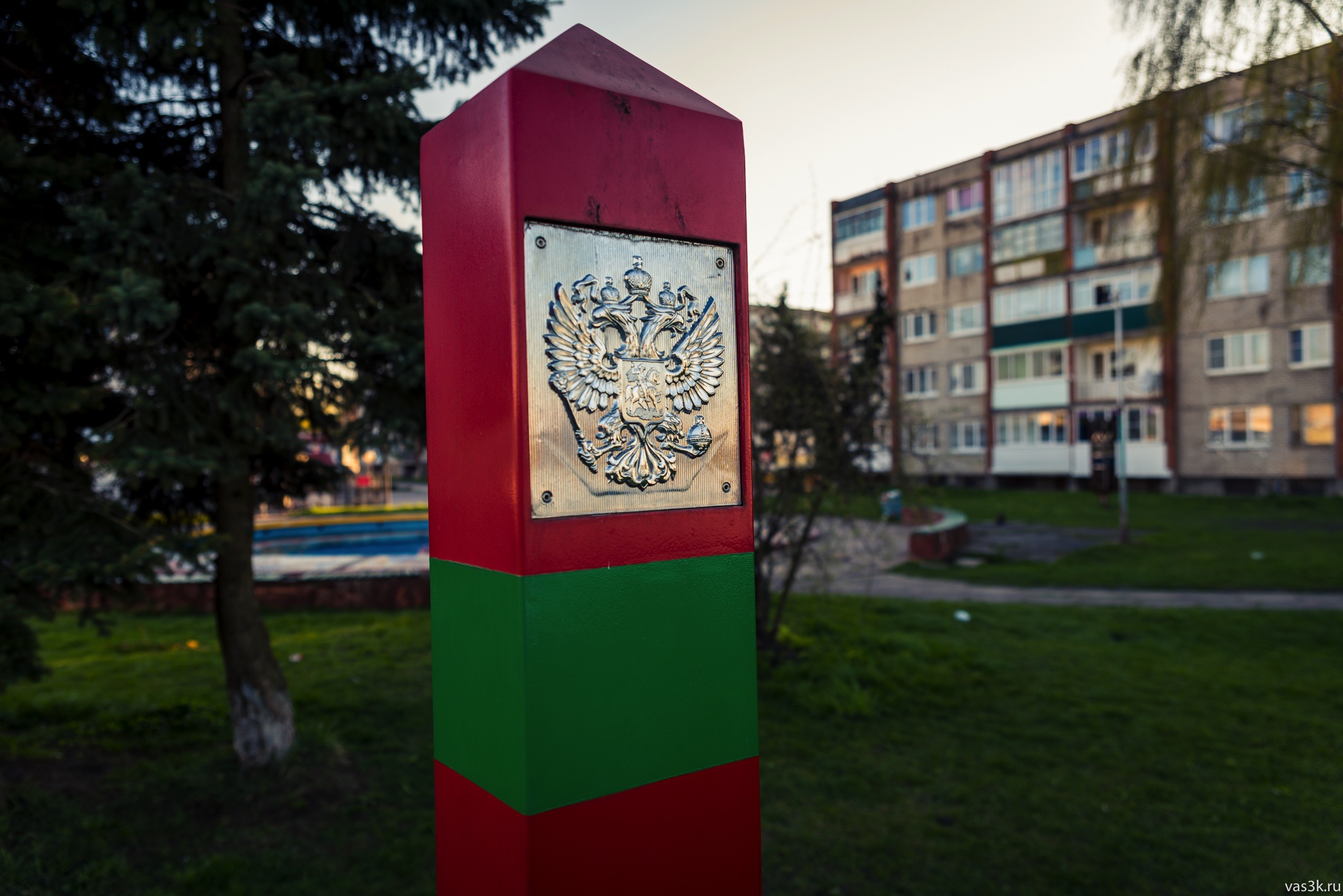
This is what a Russian Federation border post looks like. It’s pretty. But does that mean I crossed the border to photograph the sunset reflected in the coat of arms? And do the people in that Khrushchev block in the background live halfway into Lithuania?
The entrance to border control. Those cars on the right aren’t lined up to enter Lithuania. That’s where the people from the building next door and the border guards themselves park.
Kaliningrad separatism
Back in 1991, while the USSR was falling apart and I was learning to sit up and stack toy rings to the strains of Swan Lake, the former republics were on TV, starting to sort out their borders and remember their roots. The Baltic states, Belarus and Ukraine figured out who they were pretty quickly. But the Kaliningrad region no longer had a native population of its own. There was nobody to give it back to: no Lithuanians, no Poles, no Germans. Not that anyone was too keen to give it away, what with 90% of the world’s amber reserves sitting there. That’s how Kaliningrad became that “detached bit” on the map of Russia.
For all the artificiality of its creation, the Kaliningrad region is very “Russian” today. The only people brought here were workers’ families who met strict “Stalinist quality” standards. That genetic hodgepodge produced some interesting results from the point of view of genetics and evolutionary theory. Even more interesting than in Siberia.
There was something about walking through the German-Russian cemetery at night. Soldiers from both sides who fought for Königsberg are buried here. The war is over; there are no enemies anymore. The stone in the last photo bears an inscription in three languages: the dead of this cemetery call for peace.
Being so close to Europe and so cut off from the rest of Russia has had its effects. Longtime residents say things got pretty bleak in the ’90s. There was a feeling of decay and total isolation in the air. Even Moscow realized that if they didn’t start putting serious money into Kaliningrad, nobody would have to take it from them. It would leave on its own. So they started investing. They made it a special economic zone and negotiated a local border traffic agreement: residents could pop over to neighboring parts of Poland and Lithuania without passport checks, and vice versa.
Then came the whole “Crimea is ours” business, and things swung the other way again. Kaliningrad is surrounded by Lithuania and Poland, the two countries that objected most strongly to what happened. Naturally, on top of the EU sanctions, they decided to “throw in a little extra” of their own: local border traffic cards no longer work, and transit visas have become noticeably harder to get.
Every time this entirely blameless region takes another beating, separatist sentiment grows a little stronger. “Why the hell should we take the heat for THEIR decisions over THERE in Russia?” That’s how it starts. I asked people in Kaliningrad about it, and they all said roughly the same thing: they’re part of Russia and have no plans to break away, but they’re fucking sick of the isolation and want the right to visit their neighbors without all the hassle. Ask “If Europe offered to let the region join the EU, on condition that it leave Russia, would you say yes?” and after a bit of thought the answer is “Well, probably, yeah.”
People in Kaliningrad want to be Russia, but they don’t want to suffer in isolation and be first to get smacked in the fucking face by Lithuania and Poland over something they only found out about on the morning news. And you can see their point.
Pravdinsk, aka Friedland. Turned out to be a cozy little place. One supermarket on the main square, everyone out for a stroll, no thugs in sight.
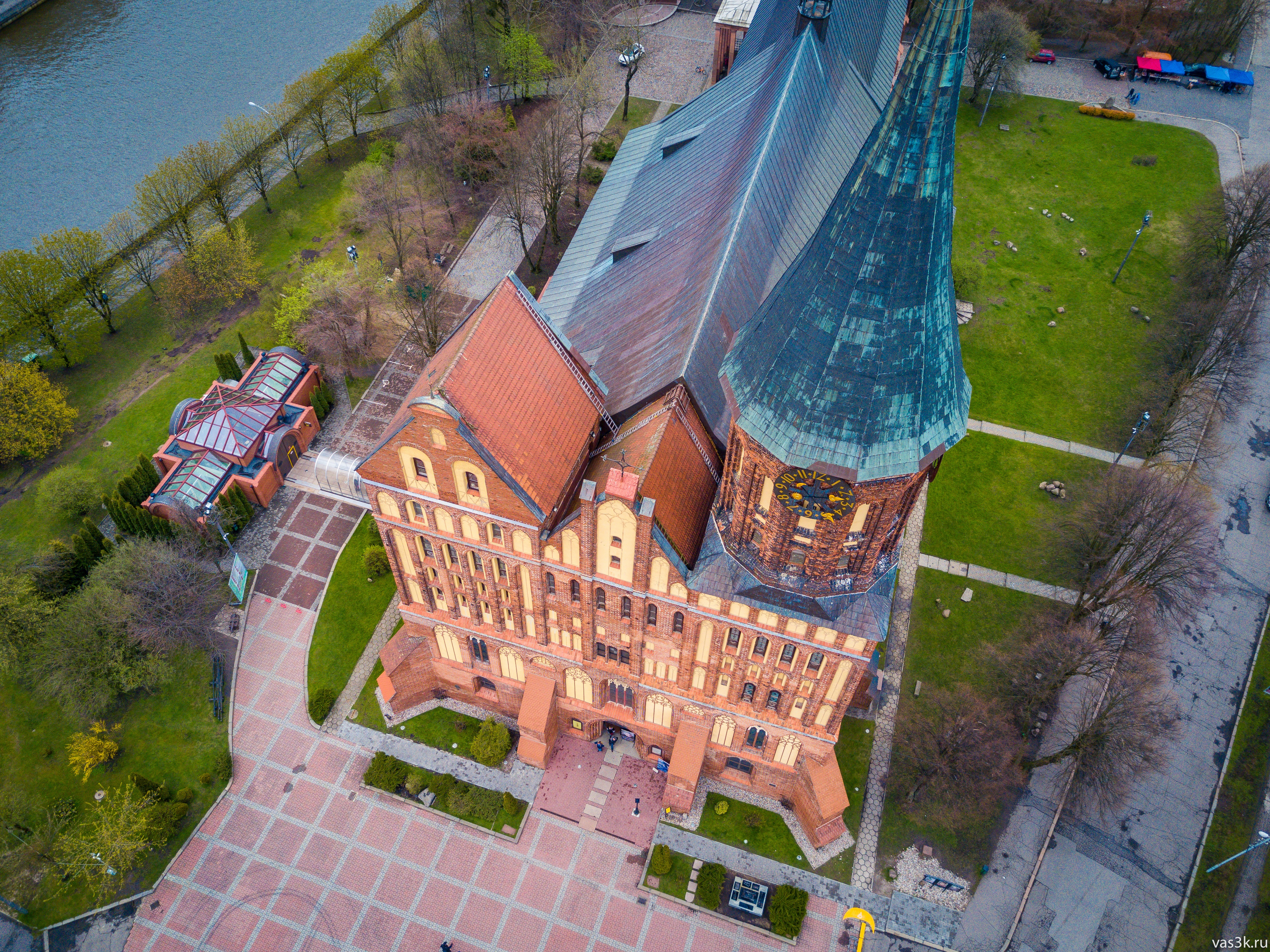
The old German church from above. Pravdinsk has a lot of heart. Almost a shame it’s so small.
And this is Baltiysk, formerly Pillau
It’s famous for the Pillau Citadel, which you can’t go inside. It’s a Russian military base. A rather grim sort of sightseeing, walking around the barbed wire.
There’s nothing to do in Baltiysk and the place is full of thugs. Don’t bother. You can look at ships elsewhere.
Time for some fucking great stories — a quick Kaliningrad digression
The border guard
We’d planned a whole tour of old battle sites on the way home. After Pravdinsk (Friedland, that is), our route took us to Zheleznodorozhny (Gerdauen). For years the town was inside a border zone you needed a permit to enter. They opened it up about 10 years ago. We hoped that being closed off might have preserved something interesting there (it hadn’t, as it turned out).
It’s a very quiet town, everyone knows each other, and the locals were suspicious of us right away. You could tell how rarely outsiders came through. Everyone turned to look, practically taking pictures of us.
So it came as no surprise when, literally on the second street we turned down, a man in uniform walked up to us. He politely introduced himself as a border guard and explained that we hadn’t broken any rules yet, but “these are the rules.” He needed to take down our details and warn us that if we went for a walk past those houses waaay over there, we’d be in violation of the state border. Funny.
There’s no official crossing around here, so getting even within a kilometer of the border carries a pretty painful penalty. The young man couldn’t have been more polite. After carefully copying our names into his little notebook, he told us the best way out of town so we wouldn’t “accidentally” cross the border, and where to find the few local sights and old German buildings. Of which, sadly, nothing remained but a pile of bricks (photos just below).
Have a good trip, he says. Just don’t go past those houses over there. That’s where the Poles are.
Ellings
Never heard the word before. An elling is basically a garage for a boat. A permanent two-story building on a riverbank or the seashore: the boat lives downstairs, the people live upstairs. Except more often than not the river dried up ages ago and the boat’s been sold. Those ellings get turned into little hideouts where you go in the evening for a beer, to grill some shashlik or smoke some weed. Basically a dacha by the water. Except unlike a dacha, you can take a cab to your elling.
Quite the local institution. You can even live in one over the summer, but every evening people you know will turn up for a smoke. At midnight they lock the entrance to the grounds and let mean, hungry dogs loose inside. The only way out of the elling then is to inch your way along the utility lines by the river and climb over a fence a meter away from a drooling, barking snout.
Quite the adventure. People in Kaliningrad love it. Honestly, I wouldn’t say no to a little two-story garage on the shore myself, even on the cold Baltic.
* * *
There were more fucking great stories here, but then it occurred to me they might hurt pretty much everyone’s feelings, and now they’re gone. So that’s it. Bye.
 Vastrik